
7-Day Melbourne Itinerary for First-Time Visitors

Australia Travel Hub contains affiliate links and is a member of the Amazon Services LLC Associates Program. If you make a purchase using one of these Amazon links, we may receive compensation at no extra cost to you. See our Disclosure Policy for more information.
Melbourne is one of those cities that rewards slowing down.
I’ve visited several times now, and I still find something I hadn’t noticed before — a laneway I’d walked past a dozen times, a suburb I’d written off, a coffee that genuinely changes the benchmark.
This Melbourne itinerary covers seven days — enough time to work through the best things to do in Melbourne, get out on the Great Ocean Road, and make it to the Yarra Valley without feeling like you’re rushing.
Three days cover the highlights. A full week — a Melbourne itinerary 1 week — lets you breathe.
If you’re planning 7 days in Melbourne and wondering how to structure it, here’s how I’d do it.
A Week in Melbourne at a Glance
| Day | Focus |
| Day 1 | CBD laneways, street art, State Library, city landmarks |
| Day 2 | MCG tour (optional), Shrine, NGV, South Yarra |
| Day 3 | Queen Victoria Market, Carlton, inner suburbs |
| Day 4 | St Kilda and Brighton Beach |
| Day 5 | Great Ocean Road — Torquay to Apollo Bay, overnight |
| Day 6 | Otways + Twelve Apostles, drive back to Melbourne |
| Day 7 | Yarra Valley — wine and wildlife |
Getting Around Melbourne
Melbourne has one of the most extensive tram networks in the world — 250km of track covering the inner city and most of the places on this itinerary.
The Free Tram Zone covers the CBD and Docklands, so you won’t need to tap on for most central travel.
Outside the free zone, you’ll need a Myki card. Pick one up at the airport, 7-Eleven, or any major train station.
It works on trams, trains, and buses and has a daily cap, so you won’t overpay even if you’re moving around a lot.
For Melbourne day trips — particularly the Great Ocean Road and Yarra Valley — you’ll either need a hire car or a guided day tour.
Both are easy to organise from the city, with tours departing from the CBD most mornings.
Best Time to Visit Melbourne
Melbourne’s weather is genuinely unpredictable regardless of the season — “four seasons in one day” is a cliché here because it’s accurate.
That said, autumn (March–May) and spring (September–November) are the most reliable.
Temperatures sit between 15–22°C, crowds are manageable, and most of the outdoor attractions are at their best.
Summer (December–February) is warm and busy — good for beaches, but accommodation books out fast around the Australian Open (January) and other major events.
One thing to know if you’re visiting in January: early January is when Melbourne itself goes quiet.
Locals escape to the coast — the Mornington Peninsula, Lorne, the Surf Coast — so the city feels emptier than usual, which is either a feature or a bug depending on what you want.
Winter (June–August) is Melbourne’s quietest and cheapest season.
It’s cold but rarely harsh, and the city’s café and restaurant scene makes it easy to spend time indoors without feeling like you’re missing much.
Where to Stay in Melbourne
For a first visit, staying in the CBD makes the most sense. You’re within walking distance of Flinders Street Station, Federation Square, the laneways, and the free tram zone — which means you can cover most of Day 1, Day 2, and Day 3 without needing transport at all.
St Kilda is a good alternative if you’d rather be near the beach and don’t mind the 20-minute tram commute into the city.
It’s quieter than the CBD at night and has a strong café and bar scene along Fitzroy Street and Acland Street.
South Yarra suits travellers who want easier access to Chapel Street, the NGV, and the Royal Botanic Gardens — and it’s well connected by train to the CBD.
For a full guide to neighbourhoods and specific hotels, see the where to stay in Melbourne post.
Day 1 — Laneways, Coffee, and the City Centre
Start with coffee.
Melbourne has roughly 4,000 cafés and takes its espresso culture seriously — it traces back to Italian and Greek migrants in the 1950s who brought espresso machines with them and opened small bars in the city’s cheap, narrow back lanes.
The flat white was refined here long before it became a global thing.
Degraves Street, Centre Place, and Hardware Lane are the most concentrated spots for laneway cafés in the CBD. Go early before the lunchtime crowd fills the narrow tables.
After coffee, walk Hosier Lane and AC/DC Lane for the street art. Hosier Lane in particular changes constantly — it’s covered floor to ceiling in murals, and artists work on it openly.
It’s one of the few places in the world where graffiti is not just tolerated but genuinely celebrated.

From there, it’s a short walk to Flinders Street Station — the arched yellow building on the corner of Flinders and Swanston Streets that has become Melbourne’s most photographed landmark — then across to Federation Square, which hosts art exhibitions, public screenings, and events year-round.
The ACMI (Australian Centre for the Moving Image) sits inside Federation Square and has a permanent free exhibition on Australian screen culture worth an hour.
Before heading south, make a stop at the State Library of Victoria on Swanston Street — it’s free, architecturally impressive, and the domed La Trobe Reading Room is one of the best interior spaces in the city.
Even if you spend just 15 minutes inside, it’s worth it.
In the afternoon, walk down Collins Street toward the Eureka Skydeck at Southbank.
The observation deck sits at 300 metres and offers a clear 360-degree view over the city and Port Phillip Bay.
The “Edge” — a glass cube that juts out from the building — is optional and costs extra, but the standard deck view is worth the entry.
End the day with dinner on the Southbank Promenade, which runs along the north bank of the Yarra River.
The precinct is busy and touristy, but the outdoor tables with city views at dusk are genuinely good.
Day 2 — MCG, the Shrine, NGV, and South Yarra
Start Day 2 based on what matters more to you — sport or history.
If sport is a priority, begin with the Melbourne Cricket Ground (MCG).
It’s the largest stadium in the Southern Hemisphere with a capacity of 100,024, and the behind-the-scenes tour takes you through the player changing rooms, the Long Room, and out onto the turf itself.
Tours run daily from Gate 3 between 10 am and 3 pm and take about 75 minutes. Even if you’re not a cricket fan, the scale of the place is worth seeing.
If the MCG doesn’t interest you, skip it and head straight to the Shrine.
Catch a tram down St Kilda Road to the Shrine of Remembrance, one of Australia’s most significant war memorials and one of Melbourne’s best-executed public spaces.

The eternal flame burns in the forecourt, and inside the crypt, panels list every Australian military unit that served. It’s free to enter and well worth an hour.
From the Shrine, walk through the Kings Domain gardens to the Royal Botanic Gardens — 38 hectares of landscaped grounds directly south of the CBD.
The gardens border the Yarra River and have a surprisingly good café inside if you want to stop for a break.
In the afternoon, head to South Yarra. Chapel Street is the main strip — a mix of boutiques, cafés, and restaurants that gets noticeably trendier as you move south toward Prahran.
The Prahran Market on Commercial Road is open Wednesday to Saturday and has a strong fresh food and deli section worth poking around.
Finish the day at the NGV International on St Kilda Road — Australia’s oldest and most visited art museum, with European and international collections spread across three levels.
This is a different building from the Ian Potter Centre at Federation Square, which holds the Australian and Indigenous art collection.
Both are free for the permanent collection, and both are worth your time.
If you only have one afternoon, NGV International is the larger and more architecturally striking building.
Check the NGV website before you go — ticketed exhibitions run year-round, and some are genuinely worth planning around.
Day 3 — Queen Victoria Market, Inner Suburbs
Queen Victoria Market has been operating since 1878, making it one of the oldest continuously operating markets in the Southern Hemisphere.
It covers seven hectares in the northern end of the CBD. One important note — it’s closed on Mondays and Wednesdays, so check the day before you go and swap Day 3 and Day 4 around if needed.
Get there before 10am if you want to browse without the crowds.
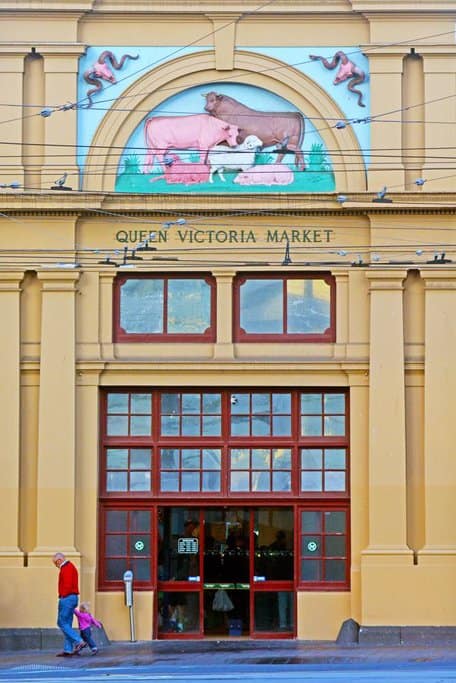
The produce section is the main draw — fresh fruit, vegetables, meat, fish, and speciality food stalls.
The general merchandise section covers everything from clothing to kitchenware and tends toward tourist-grade goods, but the food hall is worth the visit alone.
From the market, it’s a short walk east to Carlton — specifically the Royal Exhibition Building on Nicholson Street, a UNESCO World Heritage-listed building from 1880 that hosted Australia’s first Federal Parliament.
The building is attached to the Melbourne Museum, and even if you don’t go inside either, the grounds and facade are worth seeing.
The Melbourne Museum next door covers natural history and Indigenous Australian culture, and the permanent collection is free for children under 16.
After lunch, spend the afternoon in one of Melbourne’s inner suburbs. Each has a different character.
Fitzroy — Brunswick Street is the original strip, lined with independent bookshops, vintage clothing, and cafés that have been there for decades. Johnston Street has a strong Spanish and Latin influence.
Collingwood — Smith Street is the evolution of Fitzroy, a bit rawer and currently where a lot of Melbourne’s emerging restaurants are opening.
Brunswick — Sydney Road runs for kilometres north through Brunswick and Coburg, and the density of good coffee, Lebanese food, and record shops is hard to match anywhere else in the city.
For dinner, head to Lygon Street in Carlton — Melbourne’s Italian precinct, a 10-minute walk from Fitzroy.
It’s been the home of Italian restaurants, cafés, and gelaterias since the 1950s and is the natural endpoint for a day that starts in the northern suburbs.
It’s reliable, unpretentious, and one of those Melbourne streets that rewards walking the full length before you decide where to sit down.
Day 4 — St Kilda and Brighton Beach
Start the morning in the CBD with a relaxed breakfast in the laneways — this is a slower day by design.
Head to St Kilda mid-morning so you arrive before the beach crowds build.
The No. 96 tram from Bourke Street gets you there in about 20 minutes and drops you right on the foreshore.
St Kilda is about 6km south of the CBD. The beachfront on Port Phillip Bay is calm and patrolled, and the foreshore walking path runs the length of the suburb.
Luna Park sits at the north end of the beach and has been operating in some form since 1912.
The giant Mr Moon face entrance is one of Melbourne’s more recognisable sights. It’s worth walking through even if you don’t ride anything.
Acland Street, a block back from the beach, is the local eating strip — known historically for its European cake shops, and now a mix of cafés, restaurants, and bars.
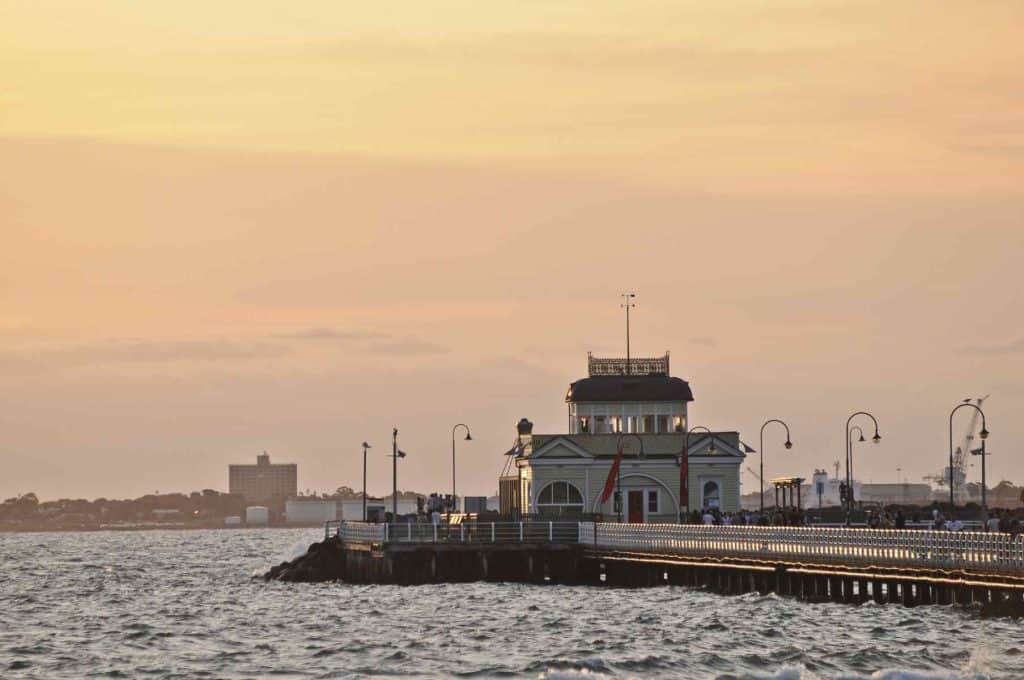
The standout experience at St Kilda is the St Kilda penguins.
A colony of approximately 1,400 Little Penguins — the world’s smallest penguin species — nests under the rocks at the end of St Kilda Pier.
Parks Victoria opened a new 150-metre viewing boardwalk in October 2025, which gives you a proper view without disturbing the birds.
Entry is free and ticketed — book through Parks Victoria’s website. The penguins come in at dusk, so time your visit accordingly.
From St Kilda, it’s a 10-minute bus ride or a 6km walk south to Brighton Beach and the famous Brighton Bathing Boxes — a row of 82 brightly painted wooden huts that line the beachfront.
They photograph well, and the beach itself is quieter than St Kilda.
Day 5 — Great Ocean Road from Melbourne to Apollo Bay
The Great Ocean Road is a two-day trip done properly.
Locals will tell you that trying to see it all in a day means you spend most of it in the car — you get to the Twelve Apostles, take a few photos, and drive straight back to Melbourne.
Overnighting in Apollo Bay changes that completely.
Leave Melbourne before 8 am and pick up a hire car if you haven’t already. Expect to pay around $60–90/day for a basic car.
There are guided day tours from the CBD for around $80–120 per person, but these cover the same 500km in one very long day — two days in your own car is a much better experience.
The Great Ocean Road starts at Torquay, about 90 minutes from the CBD.
From there, the road runs 243km west along the Victorian coast. Today’s goal is Apollo Bay — plan to arrive by late afternoon.
Bells Beach is the first stop worth making — a world-famous surf break and home of the Rip Curl Pro. It’s worth a look even when the surf is flat.
Lorne is the best coastal town on the first stretch. It’s smaller and less commercial than Apollo Bay, and the food on the main street is consistently good for lunch.
The pier, the surf club, and the beach are all walkable from the town centre.
Apollo Bay is where you’ll stay overnight. It’s a working fishing harbour with a relaxed pace — a good market on Saturday mornings, decent pub meals, and easy access to the Otway hinterland.
Book accommodation before you leave Melbourne, especially in summer.
Most travellers spend the evening in town or take a short drive into the Otways for a look at the rainforest before dark.
You can also check my 3-day Great Ocean Road itinerary here and my ultimate guide to exploring GOR.
Day 6 — Otways, Twelve Apostles, Back to Melbourne
Start early — the Twelve Apostles are at their best before the tour buses arrive, and there’s plenty to see in the Otways on the way.
From Apollo Bay, the road climbs into Otway National Park.
The Otway Fly Treetop Walk is a 600-metre elevated steel walkway through temperate rainforest canopy — worth the 45-minute stop.
The forest here is dense, the fern gullies are impressive, and it’s a completely different environment from the coast you drove along yesterday.
Continue west to the Twelve Apostles — a collection of limestone stacks rising from the Southern Ocean in Port Campbell National Park.
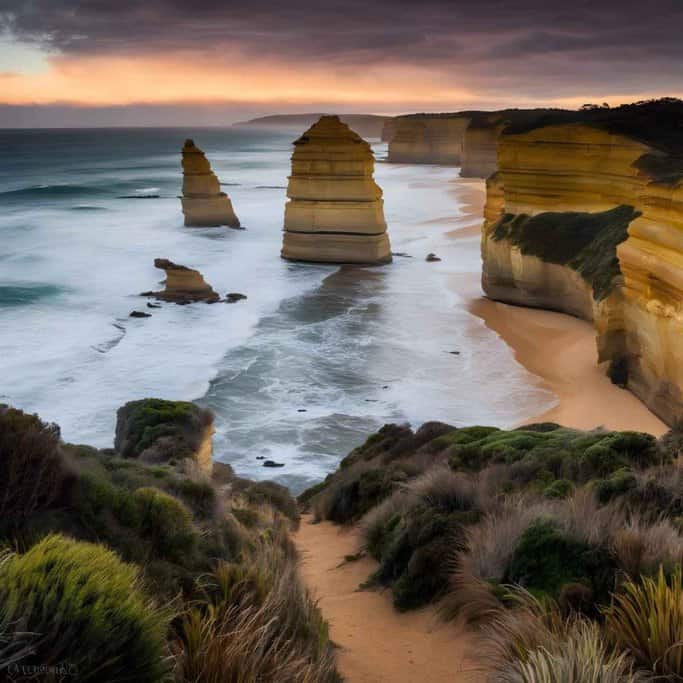
Only 7 stacks remain (one collapsed in 2005, another in 2009), but the formation is still genuinely impressive, especially in the early morning light before the crowds build.
The viewing platforms are free. A helicopter tour from the car park gives a different perspective if you want to spend extra (we did this and it was amazing!)
Loch Ard Gorge is 10 minutes further west. Named after a ship that wrecked here in 1878, the gorge is narrower and more dramatic than the Apostles — two survivors of the wreck swam into this gorge after the ship went down. Read the story before you go.
From the Twelve Apostles, it’s about a 3.5-hour drive back to Melbourne via the inland route (faster than retracing the coast road).
Alternative: Skip GOR Day 2 for Phillip Island
If wildlife is the priority over landscape, swap Day 6 for Phillip Island — about 2 hours southeast of Melbourne, home of the famous Penguin Parade at Summerlands Beach.
One important timing note: the penguins come ashore at dusk, not at a fixed time — it varies with sunrise and sunset throughout the year.
This means your evening schedule is set by the penguins, not by you.
The parade typically finishes around 9–10 pm, which puts you back in Melbourne close to midnight.
You won’t be stopping for dinner on the island — plan accordingly.
Phillip Island also has koalas at the Koala Conservation Reserve, the Churchill Island Heritage Farm, and the Nobbies coastal boardwalk with fur seals.
It’s a full day even without the Twelve Apostles detour. The Penguin Parade requires advance booking — tickets sell out weeks ahead in peak season.
Day 7 — Yarra Valley or Dandenong Ranges
Two options for the final day — pick based on what you haven’t had enough of yet.
Option A — Yarra Valley Day Trip
The Yarra Valley day trip is one of the most rewarding things to do in Melbourne’s surrounds — just 50km east of the CBD, about an hour by car.
It’s Victoria’s oldest wine region and sits at a higher altitude than most Australian wine regions, which produces cool-climate varieties.

The valley has around 120 wineries, mostly planted with Pinot Noir and Chardonnay — both of which the region does well.
Most cellar doors open around 10 am and are spread across the valley between Yarra Glen, Healesville, and the Yering area.
Yering Station, De Bortoli, and Domaine Chandon are the larger producers with good facilities.
Smaller operations like Punch and Mac Forbes are worth seeking out if you want less commercial settings.
Healesville Sanctuary is a 20-minute drive from Healesville township and is run by Zoos Victoria.
It’s focused on Australian native wildlife — platypus, echidna, Tasmanian devil, quoll, and birds of prey — and the grounds are set in bushland rather than a traditional zoo layout.
If you’re doing both wineries and Healesville in one day, go to Healesville first (opens at 9 am) and finish with wine tasting in the afternoon.
Interested in doing a wine tour to the Yarra Valley from Melbourne? Check my top 3 picks of Yarra Valley Wine Tours here.
Option B — Dandenong Ranges
The Dandenong Ranges are about 40km east of Melbourne — under an hour by car or train to Belgrave.
The ranges are covered in mountain ash forest and fern gullies, and the villages of Olinda, Sassafras, and Belgrave each have good cafés and gardens worth a slow morning.
The Puffing Billy Railway runs from Belgrave through the ranges on a heritage steam train with open-sided carriages.
The route covers 25km to Gembrook and takes about 2.5 hours each way — you can do a return trip or combine it with a walk. Book tickets in advance, especially on weekends.
The Kokoda Track Memorial Walk (also known as the 1,000 Steps) starts near Ferntree Gully and climbs through mountain ash forest to a ridge.
It’s a solid workout — most people take 45–60 minutes up. Go early on weekdays to avoid the crowds.
Melbourne Travel Tips
- Weather — Pack layers regardless of the season. The temperature can drop 10 degrees in an afternoon.
- Myki card — Grab one at the airport on arrival. Load $20 to start. Don’t leave without it.
- Free Tram Zone — covers the CBD grid and Docklands. No need to tap on within this zone.
- Hire a car — needed for the Great Ocean Road and the Yarra Valley. Book in advance, especially in summer.
- Great Ocean Road — overnight in Apollo Bay on Day 5. Trying to do it all in one day means five hours of driving and very little time at each stop.
- St Kilda penguins — book in advance via Parks Victoria. Free entry, but timed sessions fill up.
- Phillip Island Penguin Parade — tickets sell out weeks ahead in peak season. The parade is at dusk — you won’t be back in Melbourne until midnight.
- Queen Victoria Market — closed Monday and Wednesday except for the night market in summer.
- Laneways — Hosier Lane and AC/DC Lane are always open and always worth walking. Graffiti changes regularly.
- Two NGVs — NGV International on St Kilda Road has European and international art. The Ian Potter Centre at Federation Square has Australian and Indigenous art. They’re separate buildings.
- Where to eat — Broadsheet Melbourne is the best local resource for current restaurants and bars. More useful than any printed guide.
Frequently Asked Questions
How many days do you need to see Melbourne?
Three days covers the city highlights — laneways, the MCG or NGV, St Kilda, and a market. Five days lets you add the Great Ocean Road and one inner suburb day. Seven days gives you time for a proper day trip to the Yarra Valley as well.
What is Melbourne known for?
Coffee, sport, food, and street art are the four things locals will tell you. The MCG — Australia’s largest stadium with a capacity of 100,024 — is a genuine Melbourne institution, and the AFL season (March to September) shapes the city’s calendar.
Is Melbourne or Sydney better to visit?
They’re different enough that the comparison isn’t that useful. Melbourne has a stronger food and café scene, better street art, and more accessible day trips. Sydney has the Harbour, Bondi, and the Opera House. Most people who visit both have a clear preference — it usually comes down to whether you’re a city person (Melbourne) or a coast person (Sydney).
What is the best day trip from Melbourne?
The Great Ocean Road is the most popular and is worth a full day. The Yarra Valley is the better choice if wine and wildlife are more your speed. Phillip Island — home of the Penguin Parade at Summerlands Beach — is a good option if you’ve already done both.
Do I need a car in Melbourne?
Not for the city itself — the tram network covers most of what’s on this itinerary. You’ll need a car or a tour for the Great Ocean Road and Yarra Valley days.
