
The Best Places to See Jacaranda Trees in Sydney This Spring

Australia Travel Hub contains affiliate links and is a member of the Amazon Services LLC Associates Program. If you make a purchase using one of these Amazon links, we may receive compensation at no extra cost to you. See our Disclosure Policy for more information.
Sydney turns purple every spring when the jacarandas bloom, usually from mid-October through late November.
Some spots get so busy the council closes the street.
Others sit two suburbs away with the same trees and nobody around.
I love this time of year in Sydney, watching the whole city tip over into purple for a few weeks.
I used to live in Neutral Bay, and I didn’t need to go looking for jacarandas at all – they were just on the streets I walked every day.
Royal Botanic Garden, Sydney
The Royal Botanic Garden has some of the city’s oldest jacarandas, with a few dating back to the 1850s.
Walk in from the Opera House side and you’ll hit blooming trees within a few minutes, often with a harbour view behind them.
It’s free to enter and open every day, so it’s an easy one to fold into a Sydney itinerary without adding an extra day.
Circular Quay and The Rocks
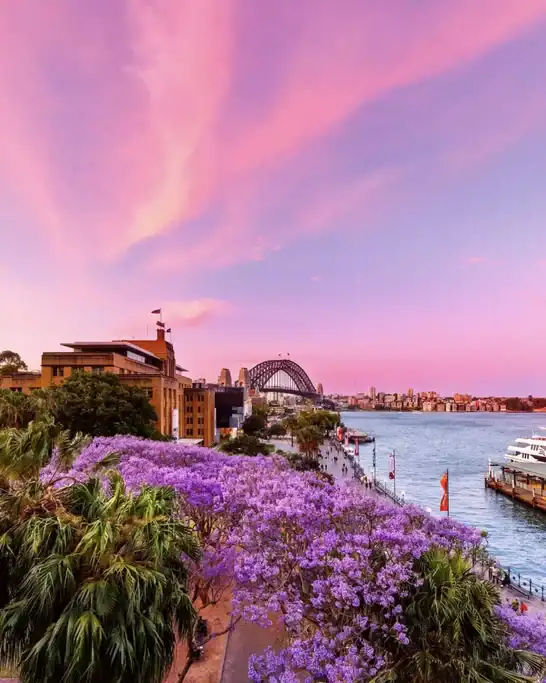
Jacarandas line the foreshore path and a few of the cobblestone lanes through The Rocks.
First Fleet Park, the strip of grass between the Museum of Contemporary Art and the ferry wharf, is the spot locals actually mean when they say “the trees near Circular Quay.”
For a different angle, take the Cahill Expressway walk – exit Circular Quay station facing the water, turn right past the ferry wharves, and ride the lift up to the pedestrian lookout for jacarandas framed against the Harbour Bridge, the Opera House and The Rocks all at once.
Go on a weekday morning if you want photos without a dozen other people in the frame.
McDougall Street, Kirribilli
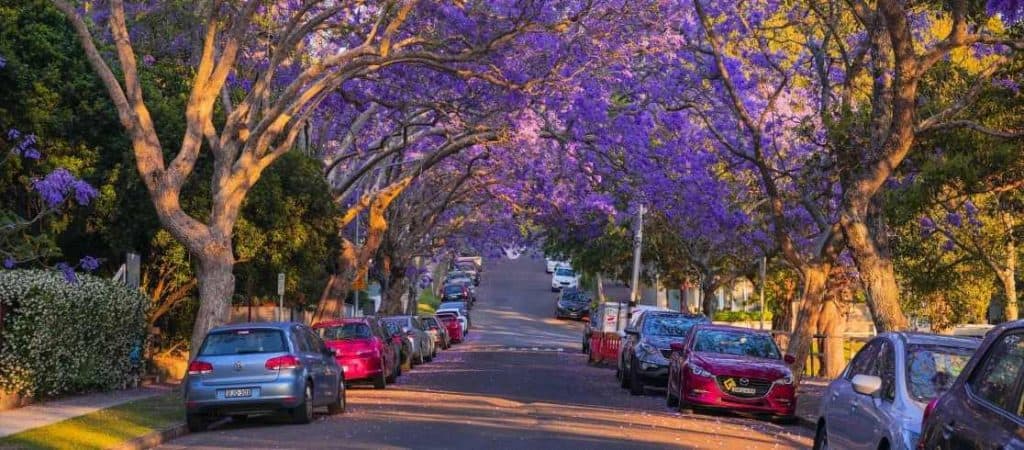
This is the one everyone’s seen on Instagram, and it earns the reputation.
Thirty mature jacarandas arch over McDougall Street, between Clark Road and Willoughby Street, forming a proper tunnel of purple.
It gets so popular that North Sydney Council closes McDougall Street and Hipwood Street to non-resident vehicles on Saturdays and Sundays, 7am to 7pm, for about six weeks from late October – and the closure is triggered by how many people turn up, not by how many flowers are out, so it can start before the trees have fully bloomed.
Don’t bother driving. Milsons Point station is a seven-minute walk, and parking around here is close to non-existent on a weekend anyway.
Lavender Bay
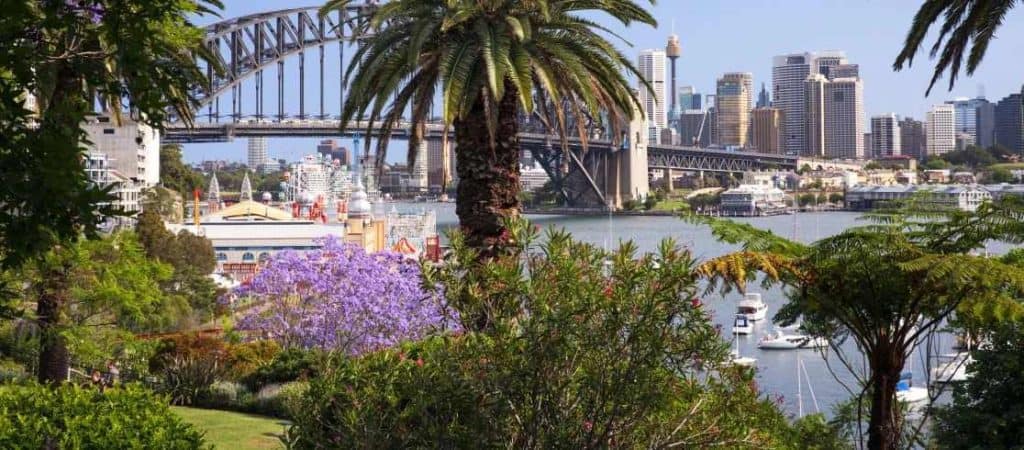
A walkable loop around from McDougall Street, on the other side of the bridge approach, and much quieter.
You get jacarandas framing the Harbour Bridge from a different angle, and a fair chance of having a whole stretch of footpath to yourself.
Wendy’s Secret Garden is tucked into the foreshore here – free, open around the clock, and worth the detour, though the paths are steep and it’s not an easy one for prams or mobility aids.
Watch where you step on the way in – fallen blooms go slippery and sticky underfoot once they’ve been on the ground a day or two.
The University of Sydney, Camperdown
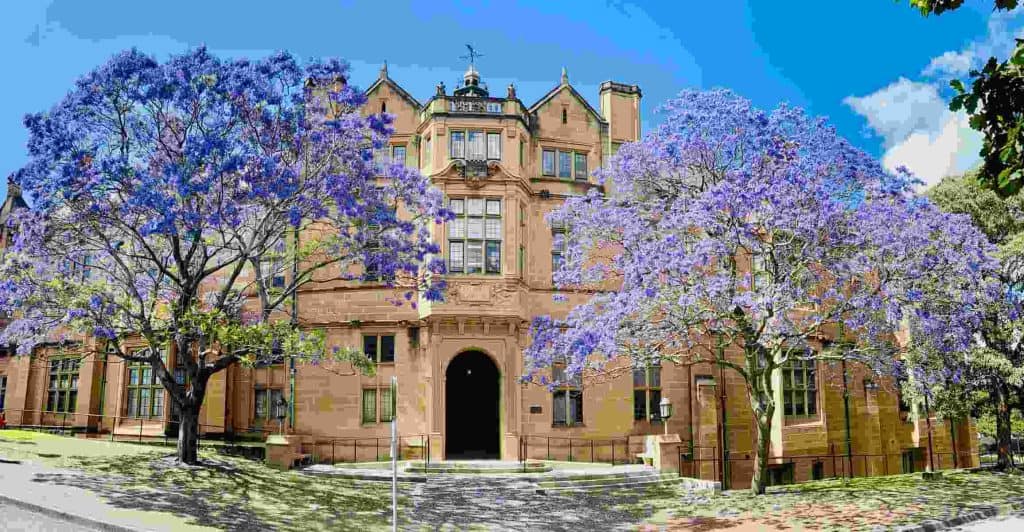
The original jacaranda in the Quadrangle died in 2016. A clone of it now grows in the same spot, and it’s already tall enough to put on a proper show.
There are more established trees scattered near the Anderson Stuart Building and along Physics Road.
This is a solid option if the street spots sound like too much effort – there’s no traffic to dodge, parking is easier on weekends, and you can wander the sandstone quadrangle at the same time.
Paddington
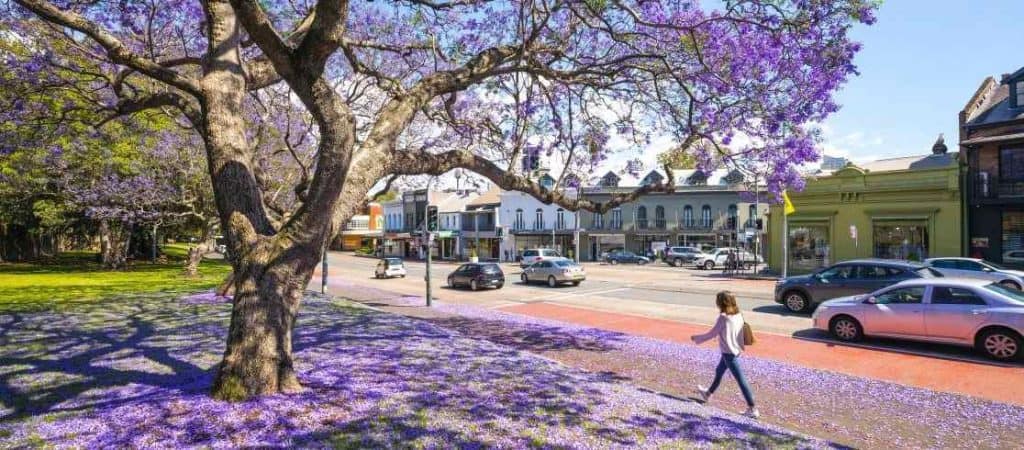
The corner of Oxford Street and Glenmore Road is the classic Paddington jacaranda shot, with Victoria Barracks’ sandstone wall running alongside a row of mature trees.
Loop through Five Ways afterwards and you can turn the walk into a proper morning, with cafes and boutiques close enough to wander between.
Woollahra and Double Bay, just to the east, have their own tree-lined streets if you want to keep walking.
Glebe, Erskineville and Newtown
Glebe Point Road is where this pocket does its best work, with long stretches of jacaranda-lined footpath running past terrace houses.
Erskineville Oval turns a proper shade of purple in season, and Ashmore Street nearby has its own dreamy tunnel of trees running past the local terraces.
Saturday mornings line up nicely with the Glebe markets if you want to combine the two, and Newtown and Camperdown have plenty more scattered through the side streets if you’re happy to wander without a fixed route.
Cathedral Street, Woolloomooloo
Cathedral Street, up near the Old Fitzroy Hotel, gives you jacarandas with Sydney Tower in the background, and it’s a genuine local spot rather than a tour-bus stop.
Judge Street, just around the corner, has its own smaller run of purple against a row of terrace houses if Cathedral Street is busy.
Neither is on most visitors’ radar, which is exactly why they’re worth the detour.
Hunters Hill and the Lower North Shore
Alexandra Street in Hunters Hill is the pick of the bunch, a pretty stretch that turns the whole street purple for a few weeks.
Neutral Bay is another one worth knowing about, and Bent Street in particular has jacarandas scattered along it – the kind of ordinary residential street locals walk past on the way to the shops rather than a landmark anyone travels for.
Neighbouring suburbs – Woolwich, Greenwich, Longueville, Wollstonecraft, Waverton – all have their own scattered trees, and most locals prefer this side of the harbour precisely because nobody else bothers coming.
Public transport is patchier out here than on the lower North Shore closer to the city, so it’s worth checking a route before you go if you’re not driving.
Kogarah
Kogarah is said to have more than 300 jacarandas across its parks and streets, which is a lot for a suburb most visitors have never heard of.
Hogben Park and Fry’s Reserve are the two easiest spots to see a decent number of trees without hunting through backstreets.
Parramatta
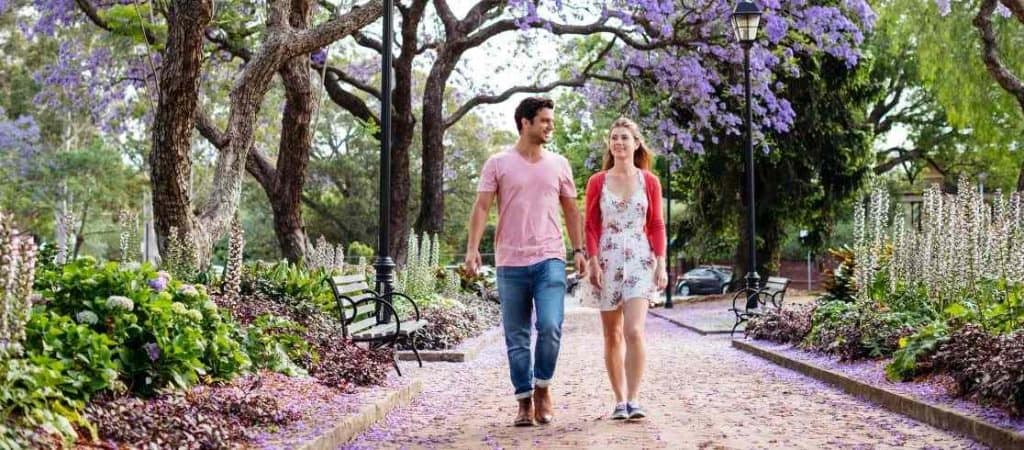
Prince Alfred Square is small but reliably full of colour through October and November.
Parramatta Park has more room to spread out, and Elizabeth Farm sits close enough to combine a heritage house visit with a jacaranda walk in the same afternoon.
This is a solid pick if you’re already spending a day in Parramatta rather than making a special trip out for the trees alone.
Camden
Argyle Street in Camden has been growing jacarandas since they were planted in 1927, making this one of the oldest and best-established displays in Sydney’s outer suburbs.
Camden Council ran a dedicated Jacaranda Festival here in past years, though it hasn’t featured on the council’s recent events calendar – worth checking Camden Council’s what’s on page before planning a trip specifically around an event, rather than just the trees.
The Australian Botanic Garden at Mount Annan is a short drive away if you want to make a full day of it.
Grafton, If You Want to Go All In
Grafton sits about 6.5 hours north of Sydney, which rules it out as a day trip, but it’s worth knowing about if jacarandas are the whole reason for your trip.
The town runs the Grafton Jacaranda Festival, Australia’s oldest jacaranda festival, with more than 2,000 trees across town.
For 2026, the festival runs Friday 30 October to Sunday 8 November, with Jacaranda Thursday – the main street closure and community day – falling on 5 November.
If a New South Wales road trip is already on your plans for spring, this is worth timing around.
Best Time to See Jacarandas in Sydney
Peak bloom sits somewhere between late October and mid-November most years, though it shifts a little depending on how warm the lead-up to spring has been.
Coastal and harbourside spots – Kirribilli, Lavender Bay, Circular Quay – tend to bloom slightly earlier than the western suburbs like Parramatta and Camden.
Early morning is the best time to visit almost anywhere on this list. The light’s better for photos and you’ll beat both the crowds and the worst of the spring heat.
Where to See Jacarandas by the Kind of Trip You’re Doing
First-time visitors get the most out of Circular Quay, The Rocks, or the Royal Botanic Garden, since you can fold jacaranda season into sightseeing you’d already be doing.
Couples should head to McDougall Street early on a weekday morning, before the crowds arrive, or try Lavender Bay for the same purple-and-harbour view with far fewer people in it.
Families are better off in a park than on a narrow residential street – Parramatta Park or Prince Alfred Square give kids room to run around without a dozen photographers in the way.
Budget travellers don’t need to spend anything. Every spot on this list is free to walk through, and the only real cost is a train or bus fare to get there.
Solo travellers and photographers should aim for weekday mornings at McDougall Street or try Woolloomooloo’s Cathedral Street instead, since it has the same purple-tunnel effect with almost nobody around.
Know Before You Go
✅ Most of the best jacaranda streets, including McDougall Street, run through residential areas, so keep noise down and don’t block driveways for a photo.
✅ Road closures around Kirribilli are timed to crowd size, not bloom stage, so check North Sydney Council’s website close to your visit date rather than assuming a set week.
✅ Fallen blooms look pretty but turn slippery once they’ve been on the ground for a day, especially after rain.
✅ Public transport beats driving at almost every spot on this list – parking is limited or banned outright around the popular streets during peak bloom, and a fair few residents are over visitors circling for a park.
✅ If jacaranda season is shaping your travel dates, it’s worth checking it against where to stay in Sydney too, since the lower North Shore books out fast once the trees start turning.
✅ If you’re chasing that one perfect purple-canopy shot, go on a weekday. Weekends from late October onward get busy fast, especially at Kirribilli and Paddington.
