
How to Spend 5 Days in Cairns — The Itinerary Worth Following

Australia Travel Hub contains affiliate links and is a member of the Amazon Services LLC Associates Program. If you make a purchase using one of these Amazon links, we may receive compensation at no extra cost to you. See our Disclosure Policy for more information.
Cairns is one of those places where the bucket list items stack up fast.
The Great Barrier Reef, the Daintree Rainforest, Kuranda, the Atherton Tablelands — and that’s before you’ve even unpacked.
Five days is enough to cover the main highlights and still have breathing room. The trick is knowing what pairs well together and what needs its own full day.
One thing to know before you arrive — Cairns has no beach. The waterfront is beautiful, but the water at the Esplanade is a tidal mudflat.
The Esplanade Lagoon (free, closed Tuesdays for cleaning) is where locals and visitors swim. If you want sand and ocean, that’s what the islands and day trips are for.
Here’s how the five days break down:
- Day 1 — Cairns city (Esplanade, Rusty’s Markets, Night Markets)
- Day 2 — Great Barrier Reef (outer reef day tour)
- Day 3 — Kuranda (Scenic Railway + Skyrail combo)
- Day 4 — Daintree Rainforest + Cape Tribulation
- Day 5 — Atherton Tablelands OR island day trip (Fitzroy or Green Island)
Getting Around Cairns
Cairns city is very walkable — the Esplanade, the Night Markets, the Pier, and Rusty’s Markets are all within easy walking distance of each other.
For day trips, and most of the highlights around Cairns require them, you have two options: hire a car or book a guided tour.
A hire car gives you flexibility for places like the Atherton Tablelands. Car hire desks are available at Cairns Airport from all the major operators, and it’s straightforward to arrange on arrival.
For the Daintree, most people book a guided tour — the Daintree River ferry crossing is manageable on your own, but a guide makes the national park sections far more worthwhile.
For the reef and Kuranda, transport is included in your booking, so no car is needed.
Distances from Cairns
| Destination | Drive from Cairns |
|---|---|
| Palm Cove | 30 mins |
| Port Douglas | 1 hour |
| Mossman Gorge | 1 hr 15 mins |
| Daintree River Ferry | 1 hr 45 mins |
| Cape Tribulation | 2 hrs 30 mins |
| Josephine Falls | 1 hour |
| Millaa Millaa Falls | 1 hr 30 mins |
| Babinda Boulders | 45 mins |
Day 1 — Cairns City
Use Day 1 to settle in and get your bearings. Cairns rewards a slow start.
Arriving in the afternoon or evening? The Esplanade, Night Markets, and Prawn Star work just as well for a half-day arrival.
Note on timing: Rusty’s Markets only runs Friday through Sunday. If you’re arriving mid-week, swap Day 1 with a different day in the itinerary and save the markets for when they’re on. The rest of Day 1 works any day of the week.
Rusty’s Markets
Start at Rusty’s Markets on Grafton Street, open from early morning on Friday and Saturday, and through to early afternoon on Sunday.
Some vendors still prefer cash, though many now accept card payments — it’s worth having some on hand just in case.
This is the best place in Cairns to try tropical fruit you probably haven’t seen before — jackfruit, rambutan, dragon fruit, soursop, and black sapote.
Grab some for the day and eat as you walk.
Cairns Esplanade + Lagoon

The Esplanade runs along the waterfront for about 2.5 kilometres and is one of the better foreshore walks in Queensland.
The Lagoon is free and open every day except Tuesdays, when it’s cleaned and closed.
It’s the main swimming spot in the city — the actual Coral Sea at Cairns is a tidal mudflat, which surprises many first-time visitors.
Cairns Night Markets
The Night Markets on the Esplanade run every evening from 4:30 pm and are worth an hour of your time.
Skip the tourist trinkets and head straight for the food court in the centre — there’s good-value Asian street food, fresh coconut drinks, and local seafood.
Dinner
For a casual, loud, and genuinely fun dinner, Prawn Star on the waterfront is one of Cairns’ most talked-about meals — it’s a floating boat-restaurant serving freshly cooked prawns, mud crabs, and seafood by the kilo. Book ahead, especially from June to September.
Ochre Restaurant is the pick if you want native Australian ingredients done properly — kangaroo, crocodile, and barramundi on the menu- and it’s a step up from the tourist strip. Note that Ochre is closed on Sundays.
Day 2 — Great Barrier Reef
Book this day as early in your trip as possible. Reef days depend on the weather, and if a tour gets cancelled, you want time to rebook.
Check the wind forecast before locking in your reef day. Trade winds from July to September can make the ocean choppy, and a rough crossing on a small boat is miserable.
Most operators post daily conditions — pick the calmest forecast day in your trip for the reef, and shuffle other activities around it.
Visiting in July? The first two weeks of July are school holidays in several Australian states, which means reef tours, Kuranda trains, and island ferries all fill up fast.
Book everything at least a few weeks in advance if you’re travelling at this time.
Which Reef Tour to Book?
Most boats depart from the Reef Fleet Terminal at Cairns Marlin Marina between 8 am and 8:30 am and return around 5 pm.
The outer reef generally offers better visibility, larger coral formations, and more diverse marine life than the inner reef.
The inner reef is closer to shore and more convenient, but it’s consistently rated lower by travellers — the extra travel time to the outer reef is worth it every time.
Reef conditions vary by site, and some areas have been affected by bleaching events while others remain in excellent condition.
A good operator will be upfront about which sites they visit and what you can expect to see — don’t choose based on price alone.
The difference in reef quality between a budget trip and a quality operator is far more than the $30–50 you might save.
Before you go, it’s worth reading our guide on what NOT to do at the Great Barrier Reef.
For swimmers and snorkellers, look for tours that include at least two outer reef snorkel sites.
For non-swimmers or those who’d rather stay dry, most boats include a semi-submersible or glass-bottom viewing section plus a floating pontoon where you stand in shallow water above the coral.
Intro scuba dives are available on the day for those who want to try it — no certification needed.
Reef tour prices run from around $217 for a standard snorkel cruise to $539+ for liveaboard diving trips.
Budget an extra $80–$120 if you want a guided scuba dive included.
When comparing prices, check whether the Environmental Management Charge (EMC) is included — some operators factor it in, others add it at checkout.
Stinger Season
From October through May, marine stingers — including box jellyfish — are present in North Queensland waters.
Reputable tour operators provide full-body Lycra stinger suits, either free or for a small hire fee. Always check what’s included before you book.
Outside stinger season (June to September), the risk is lower, but wearing a suit is still recommended on reef trips.
If You’re Prone to Seasickness
Take medication an hour before departure.
The open ocean can be choppy, especially during trade wind season from July to September.
Sit outside at the stern if you start feeling unwell — fresh air and a fixed point on the horizon both help.
Day 3 — Kuranda Rainforest Village
Kuranda sits 330 metres above Cairns in the rainforest, and the journey up is half the experience.
The Classic Combo — Scenic Railway + Skyrail
The Kuranda Scenic Railway and the Skyrail Rainforest Cableway cover the same distance between Cairns and Kuranda, but in completely different ways.
The Scenic Railway is a heritage train built in 1891 — one of Australia’s oldest working heritage railways — that winds through the Barron Gorge, through 15 hand-built tunnels and over bridges that took five years to construct.
It departs from Cairns Railway Station.

The Skyrail is a 7.5km gondola ride over the rainforest canopy with two stops — Red Peak (rainforest boardwalk) and Barron Falls (where you can look down into the gorge).
The better approach is to take the Skyrail up in the morning while you’re fresh — the gondola stops at Red Peak, and Barron Falls lets you walk around and take your time.
Getting to the Skyrail terminal: The Skyrail base station is in Smithfield, about 15 minutes north of the city of Cairns.

If you’re not on a guided day tour (which includes transfers), you can get there by taxi (~$40–55), bus 123, or Skyrail’s own hotel transfer service.
The Scenic Railway return departs from Cairns Railway Station, which is central and walkable.
Then take the Scenic Railway back down in the afternoon, when you can sit back and enjoy the views without rushing the stops.
Gold Class upgrade — the Scenic Railway offers a Gold Class carriage with dedicated seating, food and drink service, and a Carriage Host who looks after you throughout the journey.
It’s worth the extra cost if you want a more relaxed return trip.
Kuranda Village
If you have flexibility, midweek is quieter. Some stalls and smaller attractions operate reduced hours on Mondays and Tuesdays, so Wednesday through Sunday gives you the fullest experience.
That said, the Butterfly Sanctuary, Birdworld, and the Heritage Markets all operate daily — the village is never fully closed.
Once in the village, give yourself 2–3 hours.
There’s an Australian Butterfly Sanctuary (worth it, especially for families), Birdworld Kuranda, and both the Heritage Markets and the Original Kuranda Markets.
Kuranda is touristy — that’s no secret. But the markets have genuine local craft and some good Aboriginal artwork if you look past the generic souvenir stalls.
Lunch at Frogs Restaurant in the Heritage Markets is a reliable local pick — open Wednesday through Sunday, lunch only until 3 pm.
Short on days? Kuranda sits on the edge of the Atherton Tablelands, and some guided tours combine both in a single long day.
It’s a full schedule, but it’s doable if you’d rather use your last day for an island trip or the reef.
Day 4 — Daintree Rainforest + Cape Tribulation
This is the fullest day in the itinerary and covers the most ground. An early start matters.
Getting There
Cape Tribulation is roughly 2.5 hours north of Cairns.
The road crosses the Daintree River by cable ferry — it runs from 5 am to midnight daily, and the single-lane crossing can have queues during peak times.
Most first-time visitors book a guided day tour for this day, which handles the ferry logistics and includes a guide for the national park sections where a guide makes a real difference.
Mossman Gorge

Most tours stop at Mossman Gorge first, about 1 hour 15 minutes north of Cairns.
The Kuku Yalanji people are the Traditional Owners of this land, and the Mossman Gorge Centre runs guided cultural walks led by community members — allow around 1.5 hours for the full walk. It finishes at the swimming hole where the Mossman River runs through ancient granite boulders.
If you’re short on time, the self-guided walk to the swimming hole takes around 45 minutes.
Port Douglas (Self-Drive Only)
If you’re hiring a car for this day rather than booking a guided tour, Port Douglas is worth a lunch stop on the way north — it’s about 70 kilometres from Cairns and sits about 30 minutes south of the Daintree ferry.
Macrossan Street has good cafés along a walkable strip, and the town has a different feel to Cairns — quieter and less tourist-heavy.
If you’re on a guided tour, skip this — most tours have their own lunch arrangements and won’t stop here.
Daintree River Crocodile Cruise
After Mossman, most tours stop for a river cruise on the Daintree River before taking the cable ferry north — the main cruise operators are based on the south bank near the ferry crossing.
A 45-minute cruise here is the best way to spot saltwater crocodiles in the wild. Morning departures give you the best light, and guides know exactly where to look along the riverbank.
Cape Tribulation Beach
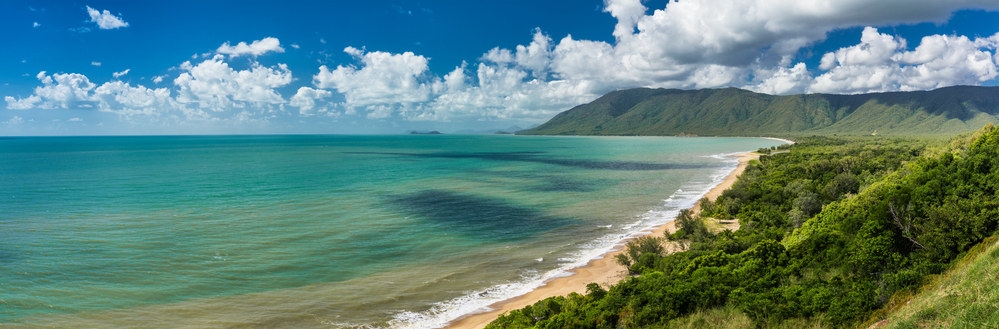
Cape Tribulation is where the rainforest meets the Coral Sea — and the beach here looks unlike any other beach in Australia.
Swimming should only be considered where local conditions are deemed safe and posted warnings are followed.
Stingers are present during the wet season, and saltwater crocodiles inhabit the waterways year-round — the signs are serious and worth reading.
The beach walk through the forest is the point — the scenery does the work.
Daintree Ice Cream Company
On the way back south, stop at the Daintree Ice Cream Company near Diwan — about 30 minutes north of the Daintree ferry crossing.
They make small-batch ice cream from tropical fruits grown on-site — wattleseed, jackfruit, black sapote, soursop — with rotating flavours daily.
It’s one of those stops that travellers bring up again and again as a highlight of the whole Daintree day.
Day 5 — Atherton Tablelands OR Island Day Trip
Day 5 is a choose-your-own-adventure based on what you haven’t ticked off yet — but also on how you’re feeling.
Day 4 is a 12-to-13-hour day. If you’re travelling with kids, older family members, or you’re just genuinely worn out after the Daintree, choose the island. It’s a far more relaxed pace and still a great day.
The Tablelands is the better pick if you’re feeling fresh and want to make the most of having a hire car.
Option A — Atherton Tablelands
The Atherton Tablelands is the highland region about 90 minutes southwest of Cairns, and it’s what most people wish they’d spent more time on.
For a deeper dive into the region, our Atherton Tablelands travel guide covers everything worth knowing before you go.
The classic route is the waterfalls circuit — Millaa Millaa Falls, Zillie Falls, Ellinjaa Falls — followed by the Curtain Fig Tree near Yungaburra (an enormous strangler fig that’s centuries old) and Josephine Falls on the way back down.
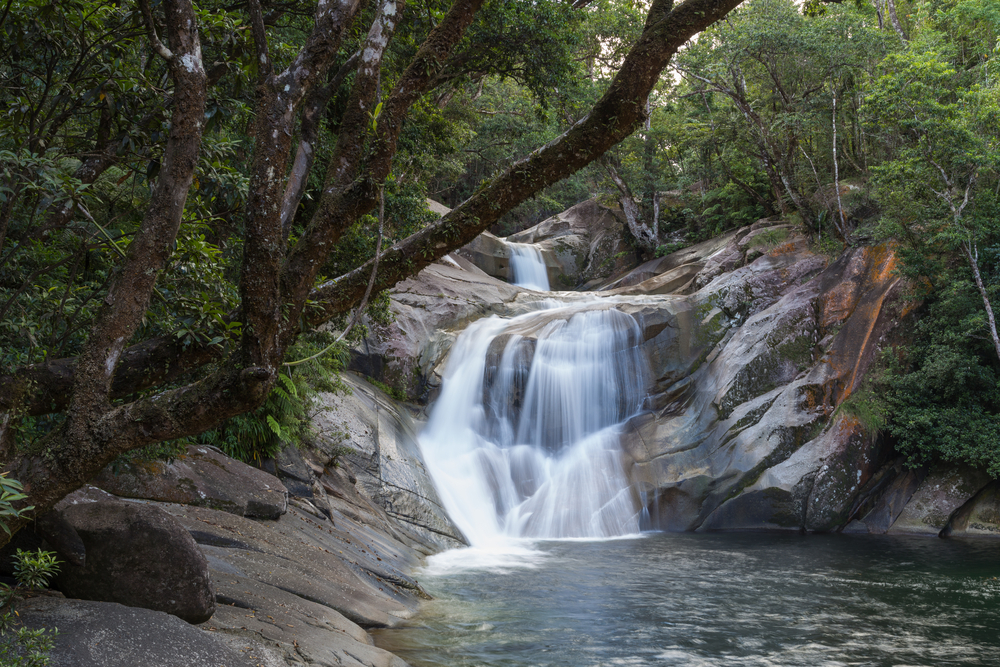
Josephine Falls has a natural rock waterslide where the water channels between granite boulders into a series of cool pools. The return walk is 1.2km and very easy — it’s one of those places that doesn’t photograph well but is far better in person.
Lake Eacham is worth adding near Yungaburra — a crater lake with clear, calm water and a good swimming spot. It’s free, with a short walking track around the rim.
Platypus sightings do occur here in the early morning, though they’re not guaranteed, and many visitors don’t spot one.
Babinda Boulders is another popular swimming hole worth adding to the day. It’s located near Babinda, about 45 minutes south of Cairns on the coastal highway — not technically part of the Tablelands highland drive, but it pairs well as a stop on the return journey.
Check conditions before getting in; the current can be strong after rain, and the area has a serious safety reputation.
If you have a hire car, this is a very doable self-drive day.
If not, guided Tablelands tours depart daily from Cairns — the all-inclusive waterfalls and rainforest tour covers the Curtain Fig Tree, Lake Eacham, Millaa Millaa Falls, Josephine Falls, and Babinda Boulders with a picnic lunch included.
Option B — Fitzroy Island or Green Island
For a more relaxed final day, either island makes a good choice — but they suit different types of travellers.
Both ferries book out during school holidays and the dry season peak, so it’s worth securing your ticket a few days ahead.
Fitzroy Island is the better pick for active travellers, teenagers, and anyone who wants to actually snorkel.

It’s 45 minutes from Cairns by catamaran, has a turtle rehabilitation centre worth visiting, good reef snorkelling directly off the beach (no boat needed), paddleboard hire, and walking trails through the rainforest.
Green Island is the smaller, more resort-style option — better suited to non-swimmers, younger kids, and families who want a beach lounger rather than an adventure.
The glass-bottom boat tour at Green Island is one of the better ones in the region if you’d rather stay dry.
What to Save for a Second Trip
Paronella Park — a Spanish castle built between 1929 and 1935 in the middle of the rainforest, about 1.5 hours south of Cairns.
The Darkness Falls night tour is the best way to visit — the ruins are lit up, and micro-bats come out after dark, making it a genuinely atmospheric experience. It needs a full afternoon and evening, and doesn’t fit neatly into a 5-day itinerary.
Cooktown — the drive north to Cooktown is one of Tropical North Queensland’s great road trips, and it’s the natural starting point for anyone continuing further into Cape York. A 4WD is essential in the wet season, and it needs its own dedicated days.
Great Barrier Reef liveaboard — if you’re a certified diver, a 2–3 day liveaboard to the Coral Sea or Cod Hole is a completely different experience from a day trip and one of the best dives in the world.
Undara Lava Tubes — accessible volcanic lava tube caves about 4 hours southwest of Cairns. Firmly a “next trip” item.
Best Time to Visit Cairns
| Season | Months | What to Expect |
|---|---|---|
| Dry season (best) | May–October | Low humidity, clear reef days, cooler temps around 25°C |
| Shoulder | April, November | Some rain, smaller crowds, better value |
| Wet season | December–March | Tropical downpours, some tour cancellations, stingers |
June to September is the sweet spot. The reef is calm, the Daintree is fully accessible, and the Tablelands are green without being waterlogged.
The wet season (December to March) is worth understanding before you book. The rains are tropical and can be intense — sometimes full days of heavy rain, sometimes just an afternoon storm.
If you visit during the wet season, the Atherton Tablelands waterfalls are at their best, and Kuranda and the Cairns Aquarium make good wet-day alternatives.
Reef trips still run, but conditions are less predictable. For more wet-season ideas, see our guide to things to do in Cairns in winter.
Is 5 Days Enough for Cairns?
Five days cover the reef, Kuranda, the Daintree, and either the Tablelands or an island day — which is the core experience most people come for.
If you want to add Paronella Park, drive to Cooktown, or do a liveaboard dive trip, plan for 7 to 10 days.
For most travellers, 5 days hits the right balance between seeing the highlights and not feeling rushed.
Where to Stay in Cairns
Cairns is compact, and most accommodation is within easy walking distance of the Esplanade, the Night Markets, and the Reef Fleet Terminal.
Staying in the city centre gives you the most convenient access to early-morning reef departures.
Prices below are a general guide and vary by season, school holidays, and availability — always check current rates before booking.
Budget — Gilligan’s Backpacker Hotel on Grafton Street is one of the most popular budget options in Cairns. It has a pool and a bar, and it’s within walking distance of everything.
Mid-range — Pacific Hotel Cairns is a reliable 4.5-star pick, consistently rated well for location and value.
It sits right on the Esplanade at the corner of Spence Street, with the Reef Fleet Terminal just a short walk away — which matters for early reef departures.
Luxury — Crystalbrook Riley brands itself as a luxury resort, with a rooftop pool and consistently praised service. It sits right on the Esplanade at the northern end of the waterfront boardwalk.
Pullman Reef Hotel Casino is another strong option at a slightly lower price point if you want luxury amenities without the full luxury price tag.
Things to Do in Cairns if You Have Extra Time
These are worth adding to your itinerary if you have an extra morning or afternoon spare.
⭐ Palm Cove — about 30 minutes north of Cairns, Palm Cove is one of Queensland’s nicest beach villages.
It’s a good half-day trip or a sunset dinner destination, and it suits anyone who wants a proper beach without taking a full island day trip. Williams Esplanade has good cafés and restaurants right on the beachfront.
⭐ Cairns Botanic Gardens — free to enter and genuinely impressive, the Botanic Gardens are one of the best half-day options in Cairns if you have time to spare.
The rainforest boardwalk and the tropical plant collection are worth an hour or two, and it pairs well with a walk through the nearby Centenary Lakes.
⭐ Hartley’s Crocodile Adventures — about 40 minutes north of Cairns on the road to Port Douglas, Hartley’s is a crocodile park with shows and encounters that are better than most wildlife parks of this kind.
It pairs well with the Daintree day if you’re hiring a car and driving yourself — it sits naturally on the route. Allow 2–3 hours.
⭐ Cairns Aquarium — a good wet-weather backup and genuinely impressive for families, with 71 exhibits covering marine life and reptiles native to Tropical North Queensland.
⭐ Cairns Jet Boat — a 35-minute high-speed ride around Trinity Inlet with spins and slides, and a decent chance of spotting crocodiles in the water.
⭐ Skydiving over the Reef and Rainforest — tandem skydives from 15,000 feet with views across the Great Barrier Reef and the rainforest on the way down.
Cairns FAQs
How many days do you need in Cairns?
Five days cover the main highlights — the reef, Kuranda, the Daintree, and one of either the Tablelands or an island. For a more relaxed pace or to add Paronella Park and a liveaboard dive, plan for 7 days.
What is the best time of year to visit Cairns?
May to October (dry season) is the most reliable time for reef trips and outdoor activities. June to August is the peak of the dry season and the safest bet if you’re planning around reef conditions.
Is the Great Barrier Reef still worth visiting?
Yes. Parts of the reef have experienced bleaching events, but large sections remain healthy, and the diversity of marine life on a good outer-reef day is still genuinely remarkable. Reef conditions vary by site — your tour operator will be upfront about current conditions.
Do you need to be able to swim to visit the Great Barrier Reef?
No. Most reef day tours include semi-submersible viewing, glass-bottom boat sections, and floating pontoons where you can observe the coral without swimming. Some operators also offer guided snorkel sessions for beginners.
Can you visit Cairns without a hire car?
Yes, for most of the main highlights. The reef, Kuranda, the Daintree, and island day trips all operate as guided tours departing from the city. The Atherton Tablelands is more convenient with a car, but guided Tablelands tours are available daily.
What should I know about jellyfish at the reef?
Marine stingers, including box jellyfish, are present in North Queensland waters from October to May. Reputable tour operators provide stinger suits. Outside this period, the risk is lower, but wearing a suit is still recommended on reef trips year-round.
Is it safe to swim in Cairns?
In the city, the Esplanade Lagoon is the safest and most convenient place to swim — it’s patrolled and free. For ocean swimming, stick to patrolled beaches on the northern beaches or on the islands. Saltwater crocodiles are present in waterways north of Cairns, including the Daintree area — pay attention to warning signs.
